Contemporary Rome
A period of experimentation.
After years devoted to figurative research and before the current journey of “Beyond Reality”, I felt the need to experiment with a different language. During this brief period, Rome became a contemporary narrative, where symbols, news stories, irony and memory intertwined with painting.
Three works born as reflections on the present, which today represent a significant chapter in my artistic journey.
A Glimpse into the Collection
Explore the works in the series. Further down, discover the story and details behind each painting.
L'asino che vola
2016 · Oil and collage on canvas · 30 × 40 cm
Available

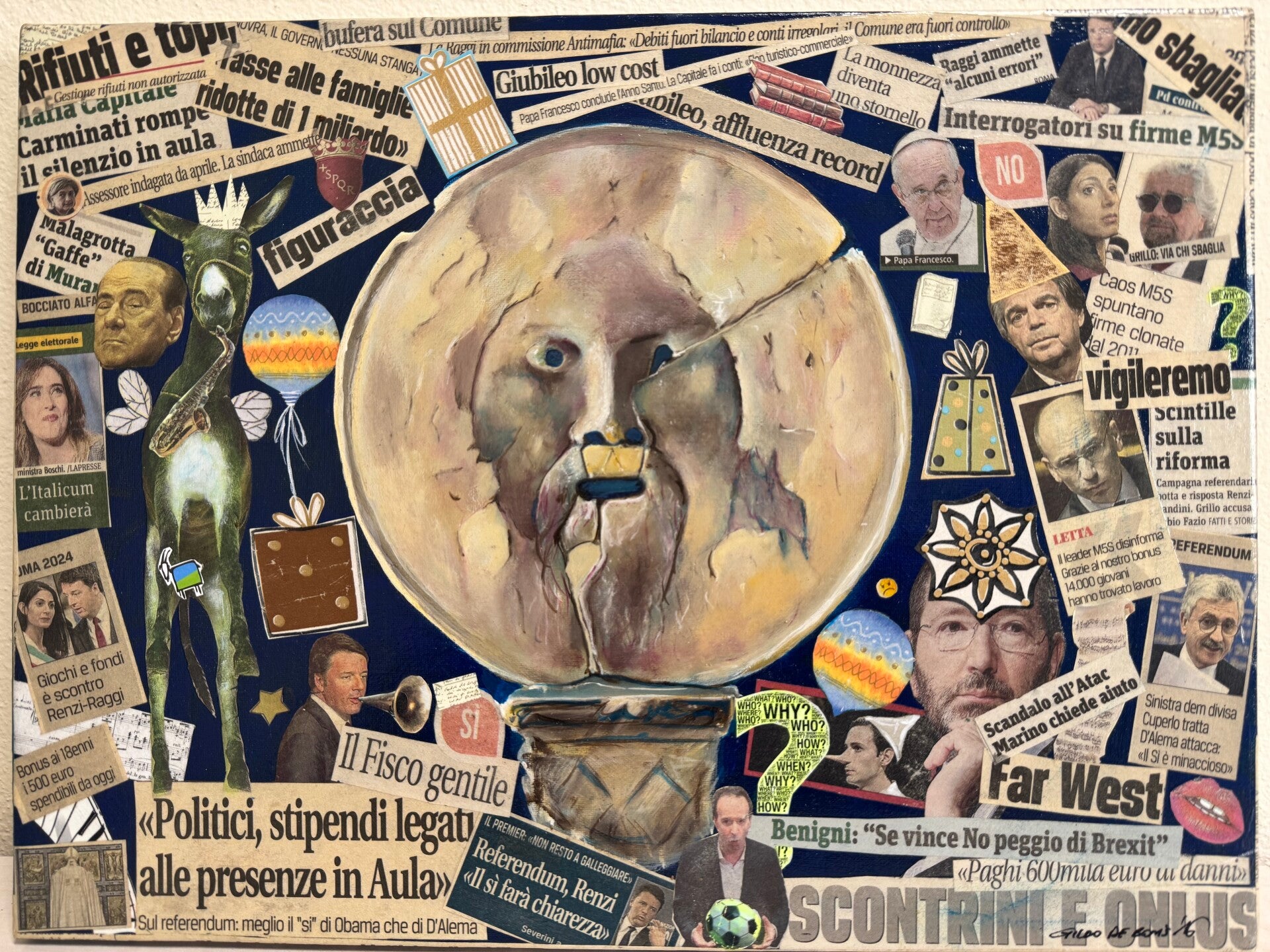
L’asino che vola was born from the encounter between painting and collage, using newspaper clippings as a testimony to the present. News, politics and the symbols of the city and of contemporary life overlap in a dense composition, where each element contributes to capturing the atmosphere of an era.
At the centre of the work, the Bocca della Verità loses its traditional appearance and is transformed into a fragile, fragmented face, almost worn away by the constant flow of news, promises and contradictions. Around it unfolds a universe made up of symbolic references and fragments of reality, in which the well-known Italian saying “l’asino che vola” — “the flying donkey” becomes a metaphor for the impossible, collective illusions and the expectations continually fuelled by contemporary communication.
Created in 2016, the work belongs to the Contemporary Rome cycle, a brief period of experimentation consisting of three works in which Rome becomes the setting for a reflection on the present. Once this experience came to an end, my artistic research moved towards a completely different language, giving rise to the journey of “Beyond Reality”.
Attacco alla barcaccia
2016 · Oil and collage on canvas · 20 × 60 cm
Private collection — Rome

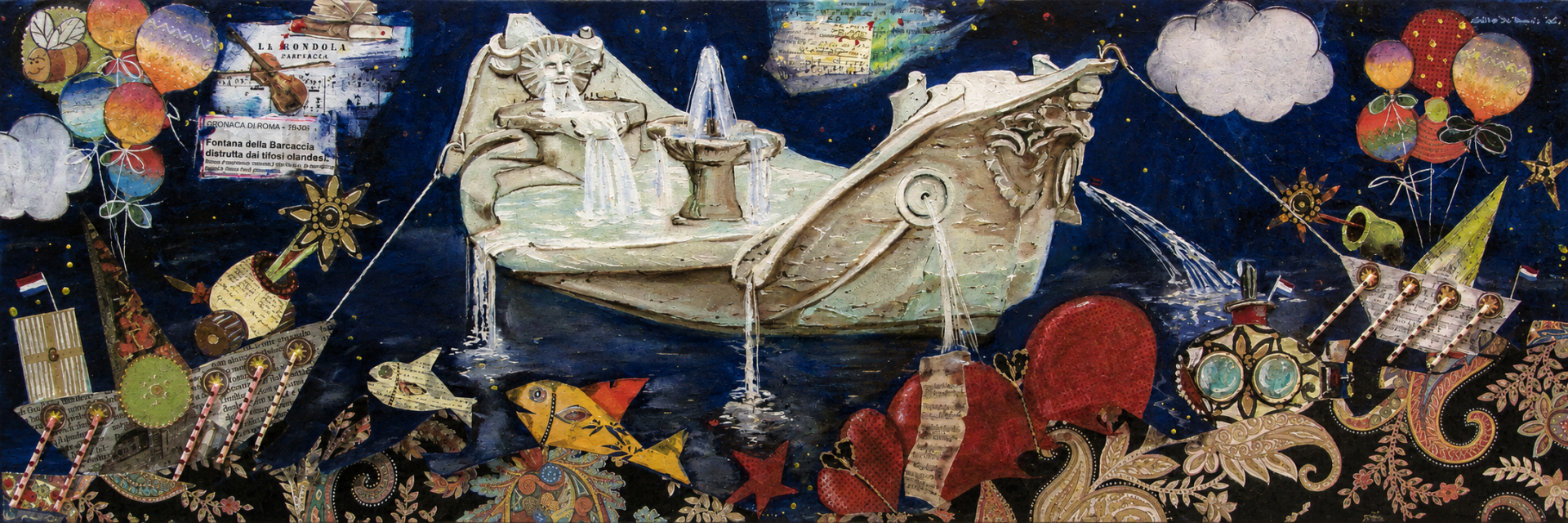
On 19 February 2015, Rome was attacked like a city under siege. Before the Europa League match between Roma and Feyenoord, hundreds of Dutch hooligans devastated Piazza di Spagna, targeting one of the city’s most precious symbols: the Fontana della Barcaccia, a masterpiece by Pietro and Gian Lorenzo Bernini. Bottles, smoke bombs and objects thrown against the monument caused damage that deeply affected not only Rome, but Italy’s entire artistic heritage.
In this painting, I chose to tell the story of that event through the language of symbols. The Barcaccia dominates the scene like a monument wounded yet not defeated, while the sea and the sea creatures become a metaphor for a city under siege. On either side of the composition, two small boats made from newspaper clippings metaphorically represent the ships of the pirates who attack the city. On both sides, the flags of the Netherlands and the Low Countries emerge, a clear reference to the Dutch hooligans who transformed one of Rome’s most historic squares into an act of vandalism against culture.
The work was created using a mixed technique of oil and collage, incorporating authentic newspaper clippings relating to the events. News enters the painting literally, merging with painting and transforming memory of the event into a reflection on the present.
Attacco alla barcaccia is not intended merely as an account of an episode of violence, but as an invitation to defend beauty. Because a monument can be restored, but every wound inflicted on artistic heritage is a wound to the identity of us all.
Tutti in piazza
2016 · Oil and collage on canvas · 50 × 70 cm
Private collection — Rome

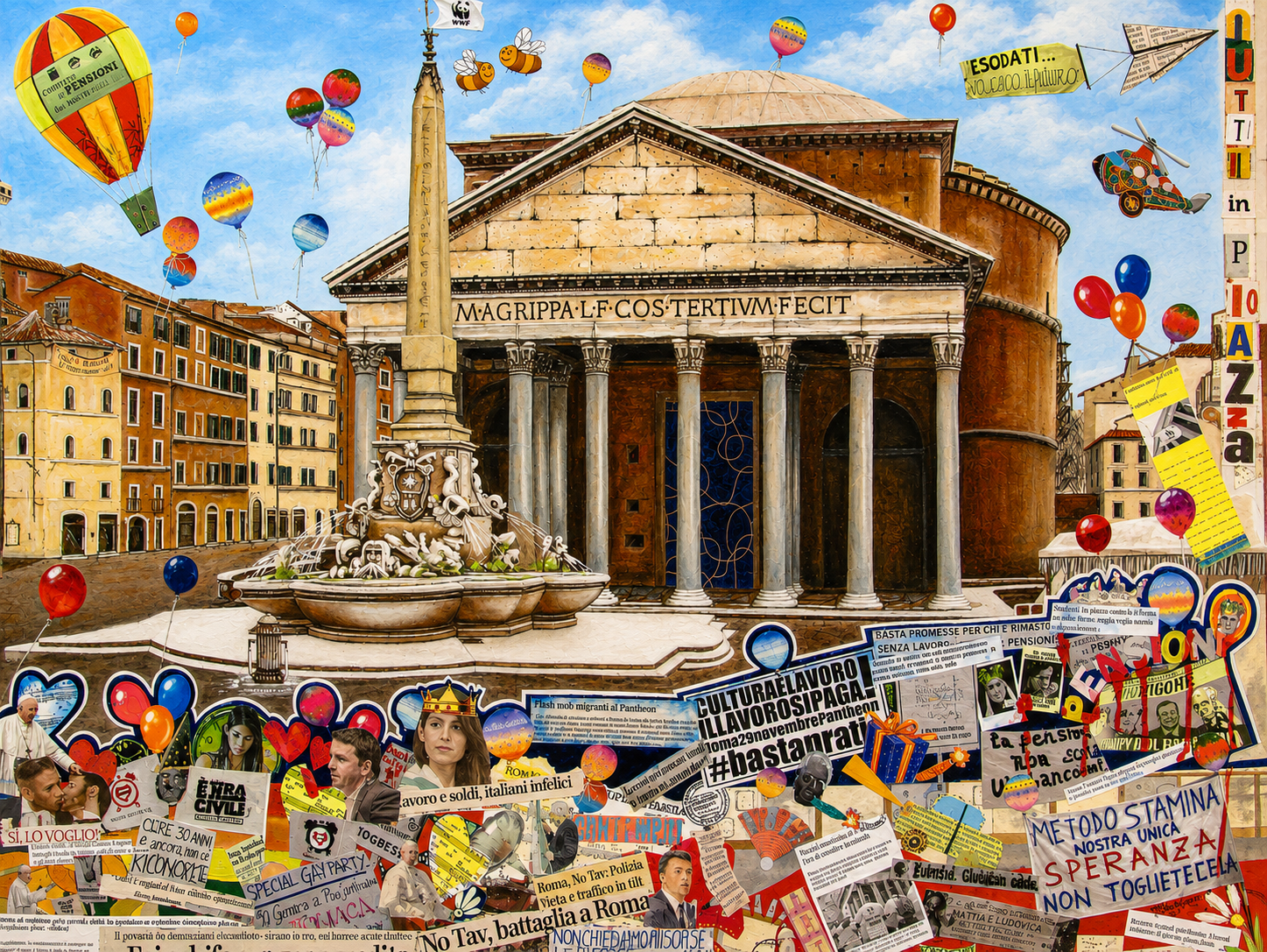
The Pantheon is not only one of the world’s most celebrated monuments. It also stands in a square that, over recent decades, has witnessed some of the most important demonstrations in contemporary Italian society.
In this work, the monument remains still, almost distant, while everything around it tells the story of our time. Through the technique of collage — newspaper clippings, flyers and references to demonstrations that actually took place in front of the Temple of Agrippa — pensioners, the unemployed, researchers, scientists, workers, healthcare professionals, movements for rights, associations and ordinary citizens come together. Protests that are different from one another, yet united by the same desire to be heard.
The Pantheon thus becomes a silent witness to contemporary history. From those two thousand years, it observes the generations passing by; today it continues to witness the transformations of society, preserving the voices of those who choose the square as a place for dialogue and democratic expression.
Painting enters into dialogue with the news. Oil paint constructs the space and restores the monumentality of the architecture, while collage introduces the reality within the painting, transforming news stories into artistic material. The colourful balloons that cross the sky lighten the composition and become, as I remember them, a reminder of the diversity of the demands — many of these demonstrations took place peacefully, enlivened by hope for change.
Tutti in piazza is a portrait of a city that continues to discuss, demonstrate and engage with itself, reminding us that participation in civic life is an integral part of Rome’s history, just like its monuments.