Reviews & Publications
Over the years, my work has been accompanied by critical texts, articles, interviews and publications that have documented the different phases of my artistic research.
Critical Perspectives
Over the years, critics and curators have accompanied my artistic journey, offering different interpretations of the various phases of my pictorial research.
Daniele Radini Tedeschi
Art critic
“He is a painter in the truest sense of the word, a craftsman of the brush, with a remarkable talent for verisimilitude.”
Pentart Gallery, Rome — June 2010
He paints not only what appeals to him, but also what he is commissioned to paint; he does not consider the subject itself, but rather “painting” in the absolute sense. He moves from the vedutismo of classical inspiration to a nineteenth-century approach to painting, succeeding in recreating that rarefied atmosphere reminiscent of Sickert or Roselli.

Exhibition catalogue, Pentart Gallery, Rome, 11–17 June 2010. Curated by Daniele Radini Tedeschi and the “Rosa dei Venti” Cultural Association.
Il Piacere – dal colore alla forma
Daniele Radini Tedeschi
Art critic — 2010
“The attention to drapery, lacework and the meticulous treatment of fabrics evokes a world of sensual, fetishistic opulence.”
The painter Gildo De Bonis began his career as a landscape painter, receiving recognition for his ability to depict nature and rural life.
One of his expressive approaches is to shift his gaze from landscapes to interiors, particularly brothels and maisons closes, describing them as places of idleness, with lamps, crinolines and softly diffused atmospheres.
Among his best-known works is the diptych Femmes fatales, a painting in which four nude women engage in a deliberately undefined narrative, their faces reflected in one another. The attention to drapery, lacework and the meticulous treatment of fabrics evokes a world of sensual, fetishistic opulence, while remaining within the tradition of Lautrec and Sickert.
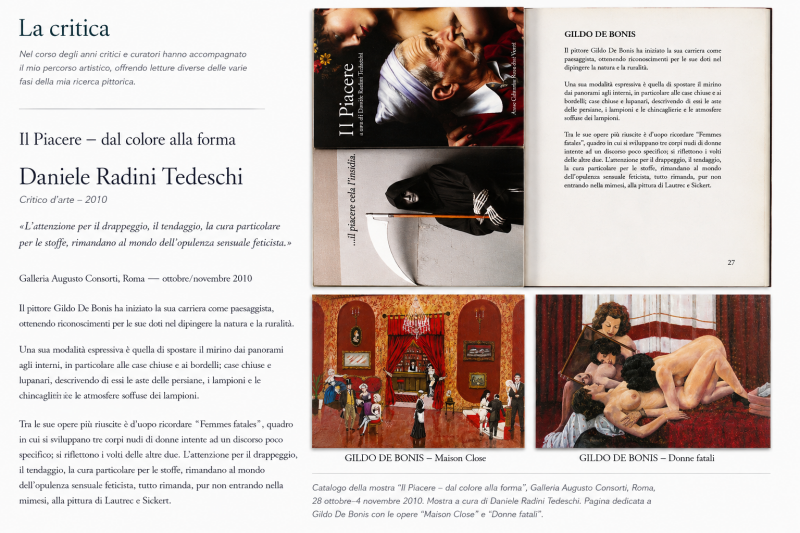
Catalogue of the exhibition “Il Piacere – dal colore alla forma”, Galleria Augusto Consorti, Rome, 28 October–4 November 2010. Exhibition curated by Daniele Radini Tedeschi. Page dedicated to Gildo De Bonis, featuring the works “Maison Close” and “Donne fatali”.
Alfredo Maria Barbagallo
Art critic
“Strongly naturalistic within a classical framework, his depictions of an elite nineteenth-century brothel reveal highly accomplished compositional qualities and remarkable care in the execution of the works.”
Marzia Modesto
Art curator
The “Bordelli” Series
“In his oil paintings inspired by the art of Toulouse-Lautrec, he captures the contradictions of the dominant bourgeoisie, portraying its vices and hypocrisies, weaknesses and fragilities.”
The compositions and painting techniques of Gildo De Bonis's Bordelli series can be seen as a reflection of Monti, Rome's “forbidden” quarter of the late nineteenth century, the city's criminal and underworld district and the centre from which new artistic avant-gardes emerged.
The Roman artist transposes the techniques and imagery of that fascinating and mysterious world into the contemporary setting of Via dei Capocci, together with scenes of nocturnal venues and “maisons closes”, the brothels once frequently found in Monti.
In his oil paintings inspired by the art of Toulouse-Lautrec, he captures the contradictions of the dominant bourgeoisie, portraying its vices and hypocrisies, weaknesses and fragilities. Many of his paintings depict scenes of everyday life, at times intruding almost brutally into the privacy of both prominent and ordinary figures of contemporary Rome, and are inspired, not surprisingly, by current affairs, politics and the everyday details of our time.
Scenes of daily life, observed in café-concerts, dance halls, brothels and celebrated theatres, are portrayed with caustic and scintillating irony, revealing a highly personal and distinctive artistic language.
Mariagrazia Strafella
Art critic
“The painter does not merely see, but observes, capturing everyday life within interior settings studied down to the smallest detail.”
The characterisation of the subjects — sometimes with expressionless faces, sometimes with faint smiles and an almost comic-book quality — together with the attention devoted to bodies, poses and settings, reveals the strong influence of Impressionism on the artist.
The painter does not merely see, but observes, capturing everyday life within interior settings studied down to the smallest detail. He colours and emphasises, leaving nothing to chance in his subjects, always refined and elegant.
Like marionettes, they are first created, then guided and finally placed within their surroundings.
In his paintings, the artist often returns to the use of the mirror, through which he enjoys challenging himself, always achieving a striking result that invites reflection.
Is this perhaps his way of bringing the emotional dimension of his figures to the surface?
Dr Mariagrazia Strafella
Art critic
Claudio Lepri
Art critic
A refined interpreter of erotic atmospheres, with remarkable compositional skill
“The artist Gildo De Bonis displays a marked compositional quality in every form of expression.”
A painter who approaches art through hyper-realist forms of expression, he proves particularly accomplished in depicting interior atmospheres, where his artistic vein is enriched by images of nineteenth-century maisons closes, painted with remarkable aesthetic refinement. A style in which the definition of the work as a whole is almost the counterpoint to limited spaces: the elegance of the furnishings, the abundance of carefully studied colour contrasts, together with sensations of anticipation surrounding the erotic moment, the expressiveness of the figures and compositional harmony. In this sense, one could define De Bonis’s psychological interplay of gazes as a series of highly accomplished personal interpretations.
The artist’s interpretation of similar themes reveals a De Bonis intent on creating pictorial compositions in which forms are harmonised through colours and atmospheres, at times more or less explicit, yet always veiled by drips of colour that allow the underlying tonal qualities to emerge without ever concealing them completely.
A pleasing artistic interplay between two styles distinguishes De Bonis and makes him particularly eclectic: some works openly express eroticism through the passionate portrayal of women displaying their sensuality within the erotic game, where the mirror completes the visual space and continually heightens the expression of desire; visions of paradise, filled with naked bodies moving freely and without restraint, complete this world in all its fullness.
Gildo De Bonis also reveals himself to be a remarkable portraitist in works where he chooses ink as the basis of the drawing, combining it with vivid chromatic contrasts.
The hallmark of the portraitist lies in his ability to depict intense faces and capture fleeting moments projected into the present, expressing in those gazes the vitality of a moment in succession. All of this demonstrates his ability to define atmospheres of absolute realism, capturing looks and desires through a confident command of artistic language.
At this point, Gildo De Bonis becomes a composer of themes in which he is able to move freely between different pictorial styles, creating appropriate atmospheres in which reality and imagination, the virtual and the expressive, are treated with remarkable compositional ease.
Prof. Claudio Lepri
Art critic
PUBLICATIONS & PRESS
Articles, interviews and publications that, over the years, have documented my artistic journey, exhibitions and the different phases of my research.
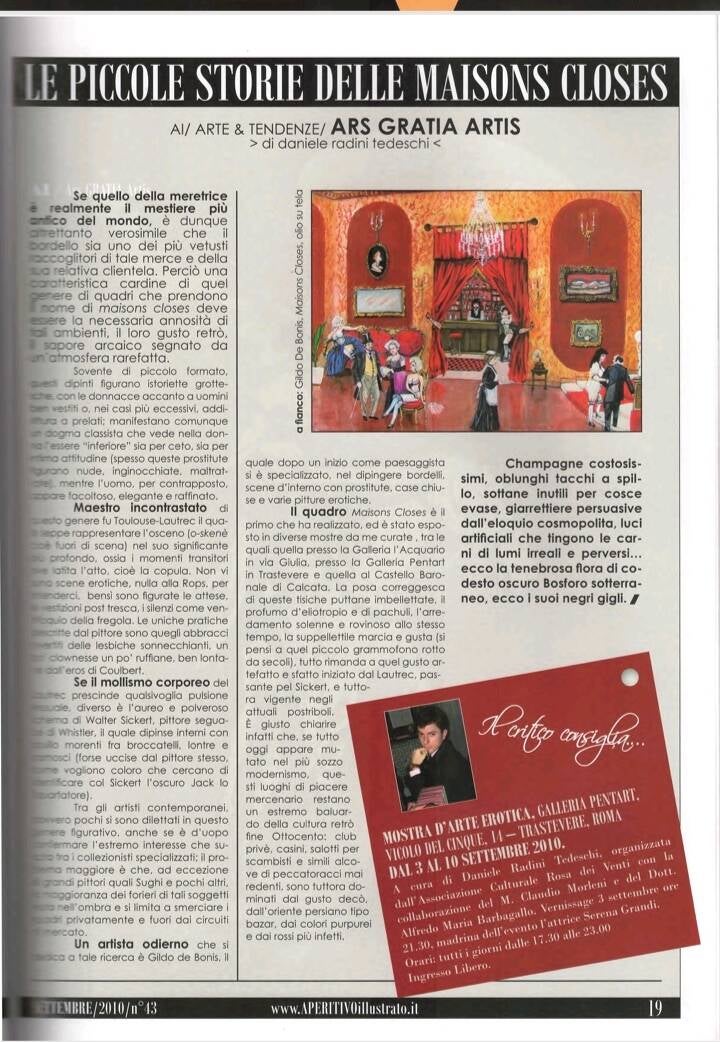
1. L’Aperitivo Illustrato — September 2010
L’Aperitivo Illustrato
National magazine — No. 43, September 2010
In 2010, L’Aperitivo Illustrato published a review by Daniele Radini Tedeschi devoted to the painting of Gildo De Bonis and his exploration of interiors and the Maison Close. The publication followed the Critics’ Prize awarded to De Bonis as part of the Trofeo Calcata.
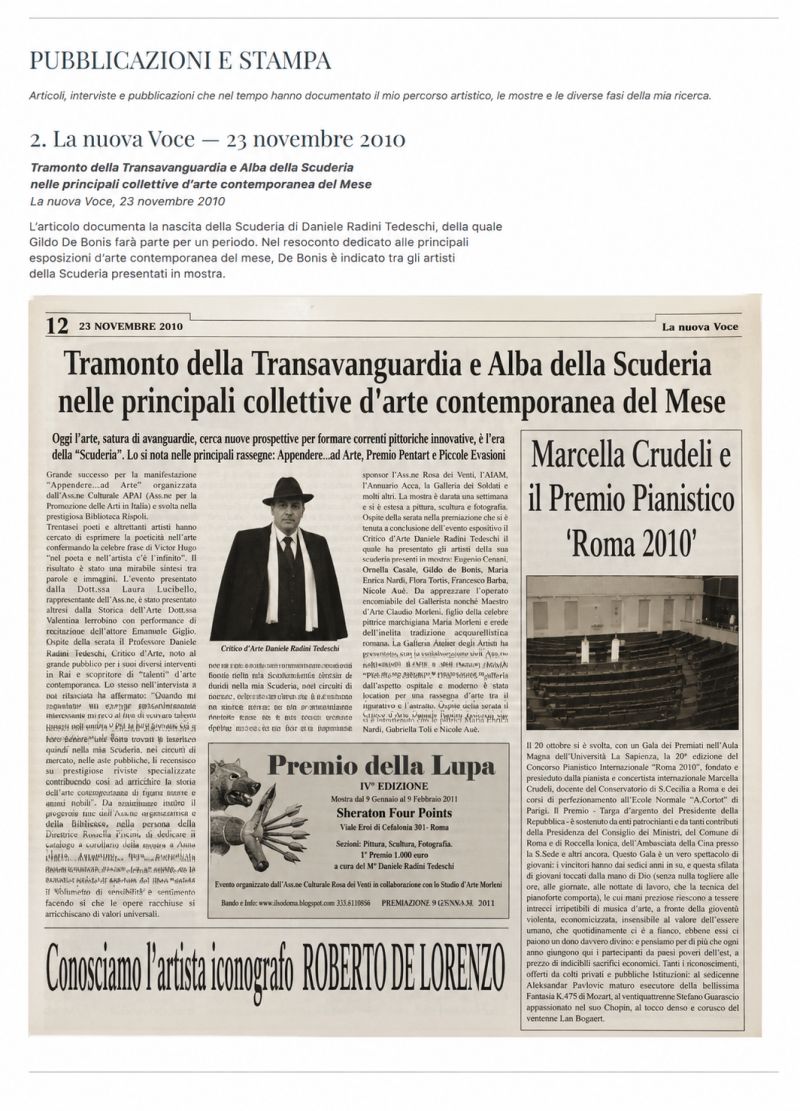
2. La nuova Voce — 23 November 2010
“Tramonto della Transavanguardia e Alba della Scuderia nelle principali collettive d’arte contemporanea del Mese”
The article documents the founding of Daniele Radini Tedeschi’s Scuderia, of which Gildo De Bonis would be a member for a period of time. In its report on the month’s main contemporary art exhibitions, De Bonis is listed among the Scuderia artists whose works were presented in the exhibition.
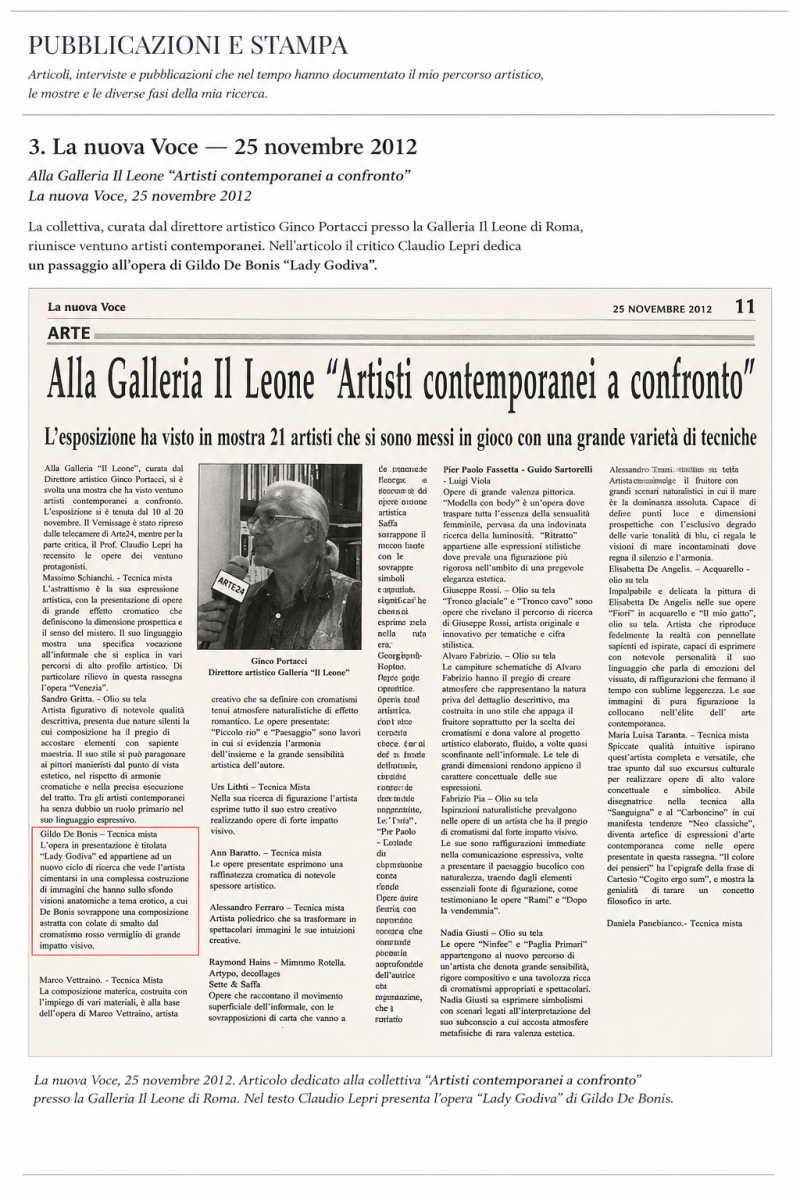
3. La nuova Voce — 25 November 2012
“Alla Galleria Il Leone ‘Artisti contemporanei a confronto’”
La nuova Voce, 25 novembre 2012
The group exhibition, curated by artistic director Ginco Portacci at Galleria Il Leone in Rome, brought together twenty-one contemporary artists. In the article, critic Claudio Lepri devoted a passage to the work of Gildo De Bonis:
“Gildo De Bonis — Mixed media. The work on display is entitled Lady Godiva and belongs to a new cycle of research in which the artist engages with a complex construction of images set against anatomically inspired visions with an erotic theme, over which De Bonis superimposes an abstract composition with a striking chromatic impact, using vivid colours.”
Video Testimony
Arte24 – Rete Oro, 2012
Excerpt from the television programme Arte24 on Rete Oro, recorded during the exhibition “Artisti contemporanei a confronto” at Galleria Il Leone in Rome. Gallery owner Ginco Portacci introduces Gildo De Bonis’s work to the audience.
4. La nuova Voce — 25 November 2012
“Dal classico all’Erotico Informale” – Solo Exhibition by Gildo De Bonis
La nuova Voce devoted an article to Gildo De Bonis’s solo exhibition “Dal classico all’Erotico Informale”, presenting the artist’s journey through the different expressions of his pictorial research, from figurative painting to informal experimentation.
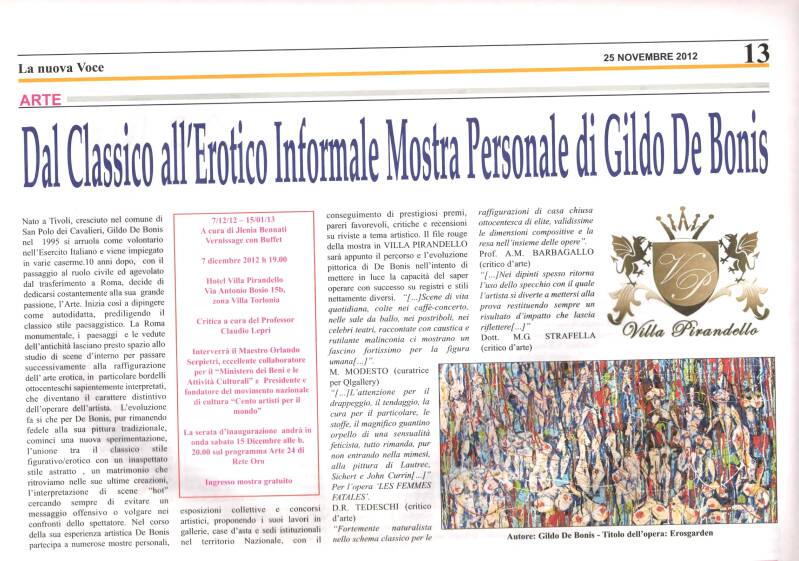
La nuova Voce, 25 novembre 2012 — articolo dedicato alla mostra personale “Dal classico all’Erotico Informale”.
5. Inside Art — 21 December 2012
“Solo prostitute e bordelli”
Inside Art devoted an article to Gildo De Bonis’s solo exhibition, which opened in Rome in December 2012. The feature explores his pictorial research into the interiors of maisons closes and the atmospheres of prostitution, focusing on his exhibition journey and on the artist’s distinctive interpretation of eroticism.
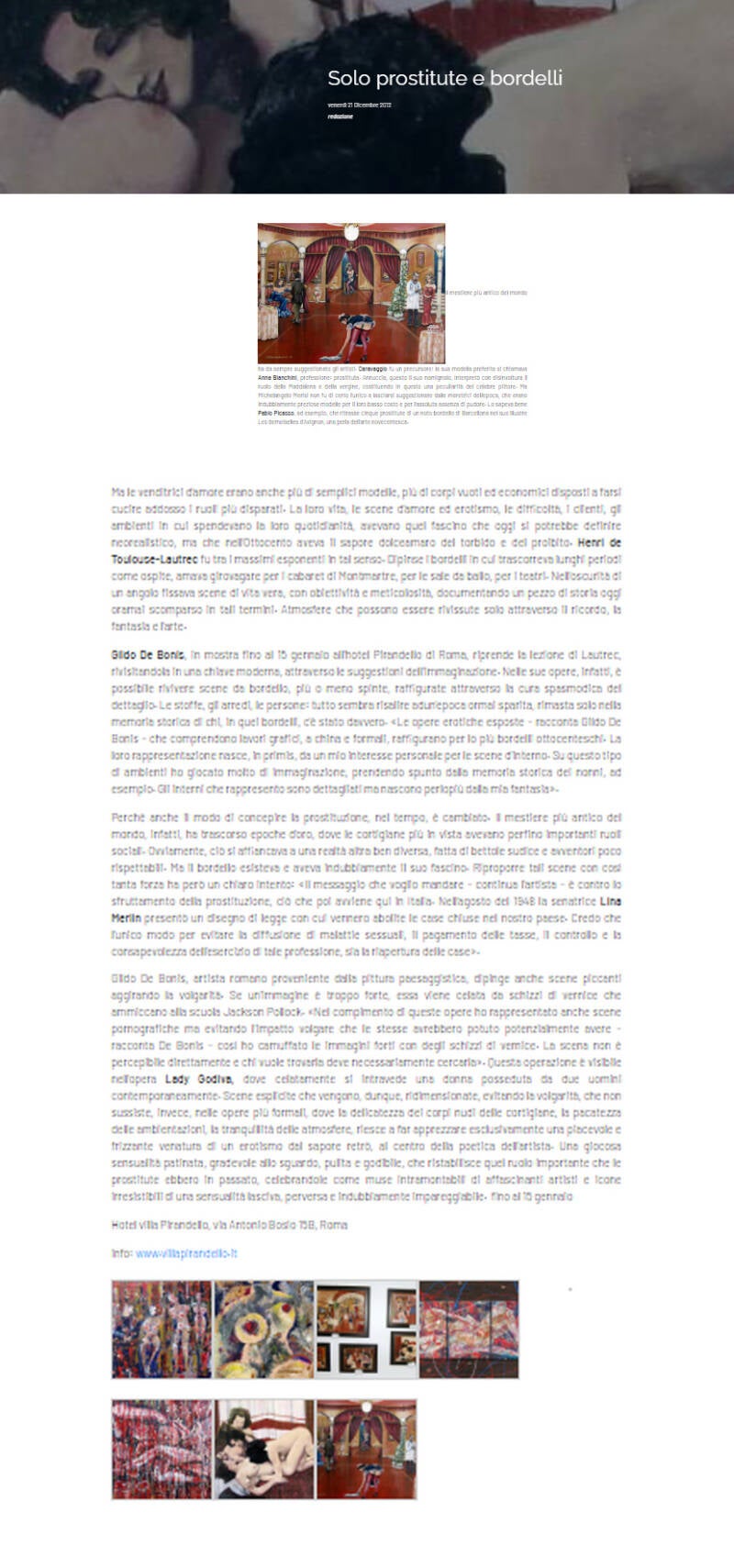
Inside Art, 21 December 2012 — “Solo prostitute e bordelli”.
OTHER PUBLICATIONS & MENTIONS
Alongside the main articles and features, over the years my artistic journey has also been documented by cultural websites, online magazines and publications devoted to art and exhibitions.
Abitare a Roma
Gildo De Bonis’s artistic and exhibition activity was also featured in Abitare a Roma, as part of its cultural coverage of events and artistic initiatives in the capital.
Arcadja Art Magazine
Reports on Gildo De Bonis’s artistic and exhibition activity also appeared in Arcadja Art Magazine, an international platform devoted to art, artists and the art market.
FROM THE ONLINE PRESS ARCHIVE
Some online publications that documented my artistic journey are no longer available on their original websites. I preserve their memory here through documentation and references from the time.
lungotevere.net — 7 September 2010
“Voglia di... Pennello”
An article devoted to Gildo De Bonis’s painting and to the research he was developing at the time, between figurative representation, interiors and erotic themes.
lungotevere.net — Galleria L’Acquario
The website lungotevere.net also documented Gildo De Bonis’s participation in an exhibition at Galleria L’Acquario in Rome, presenting his work within the context of his artistic activity at the time.
Interviews & Encounters
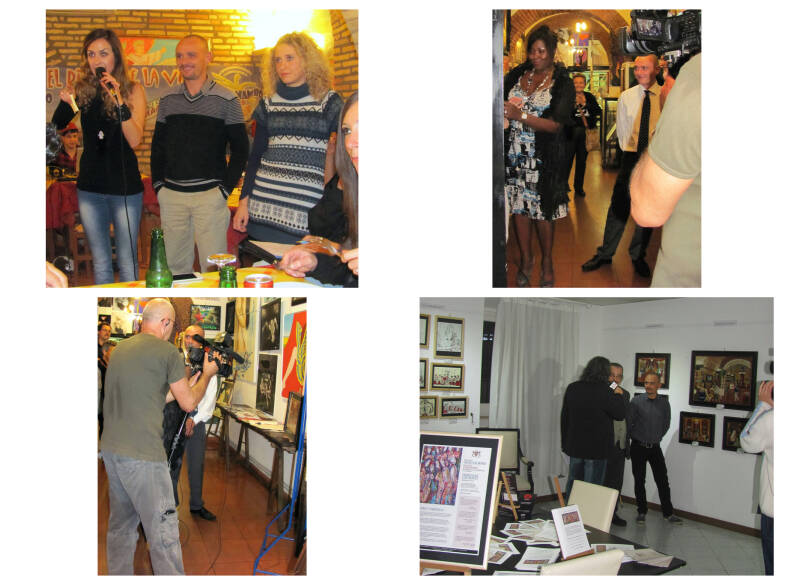
Over the years, exhibitions and events also became opportunities for interviews, presentations and encounters with the public, documenting through images and personal accounts some moments of my artistic journey.