Beyond Reality
Real monuments. Imagined emotions.
A Glimpse into the Collection
Explore the works in the series. Further down, discover the story and details behind each painting.
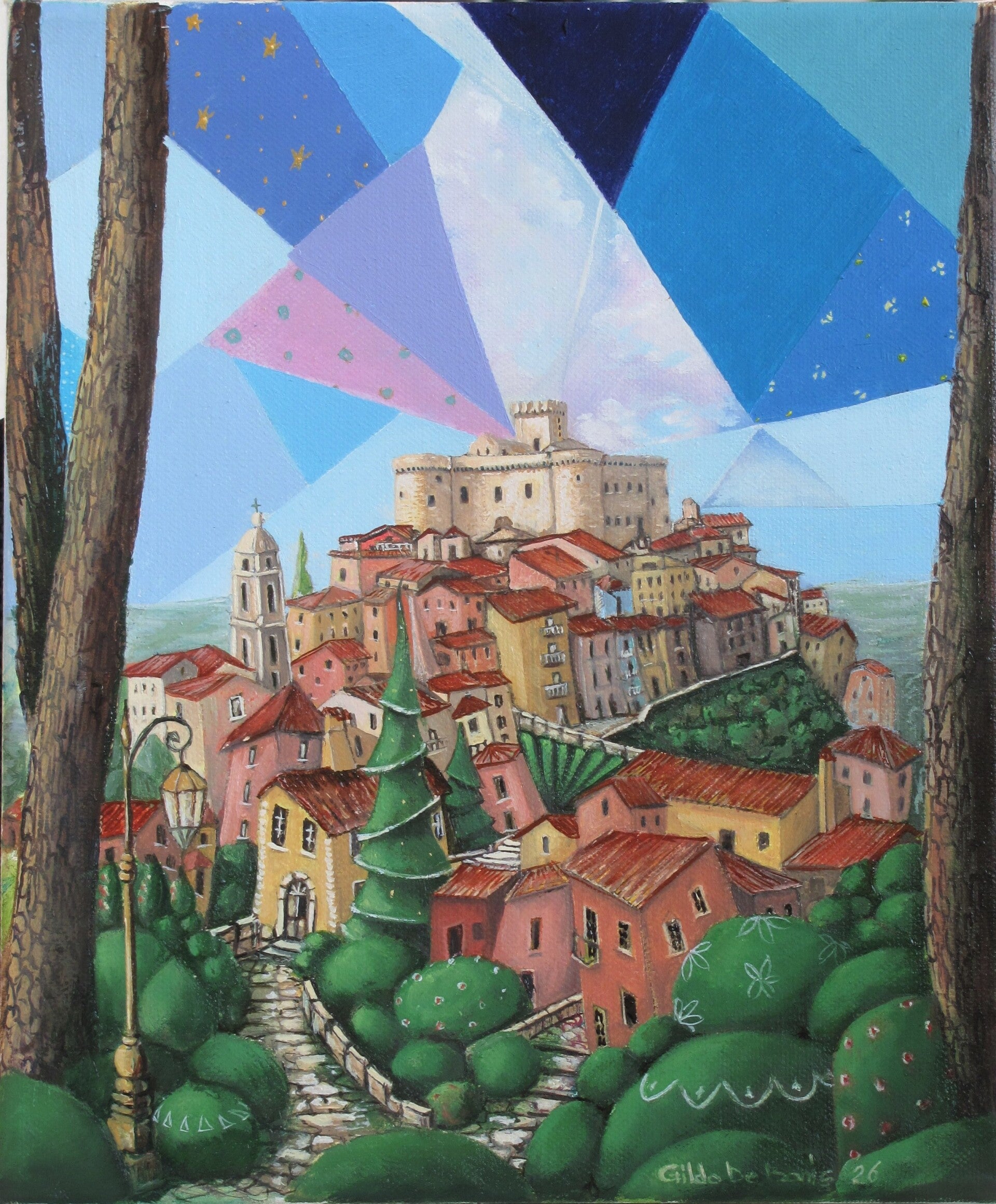
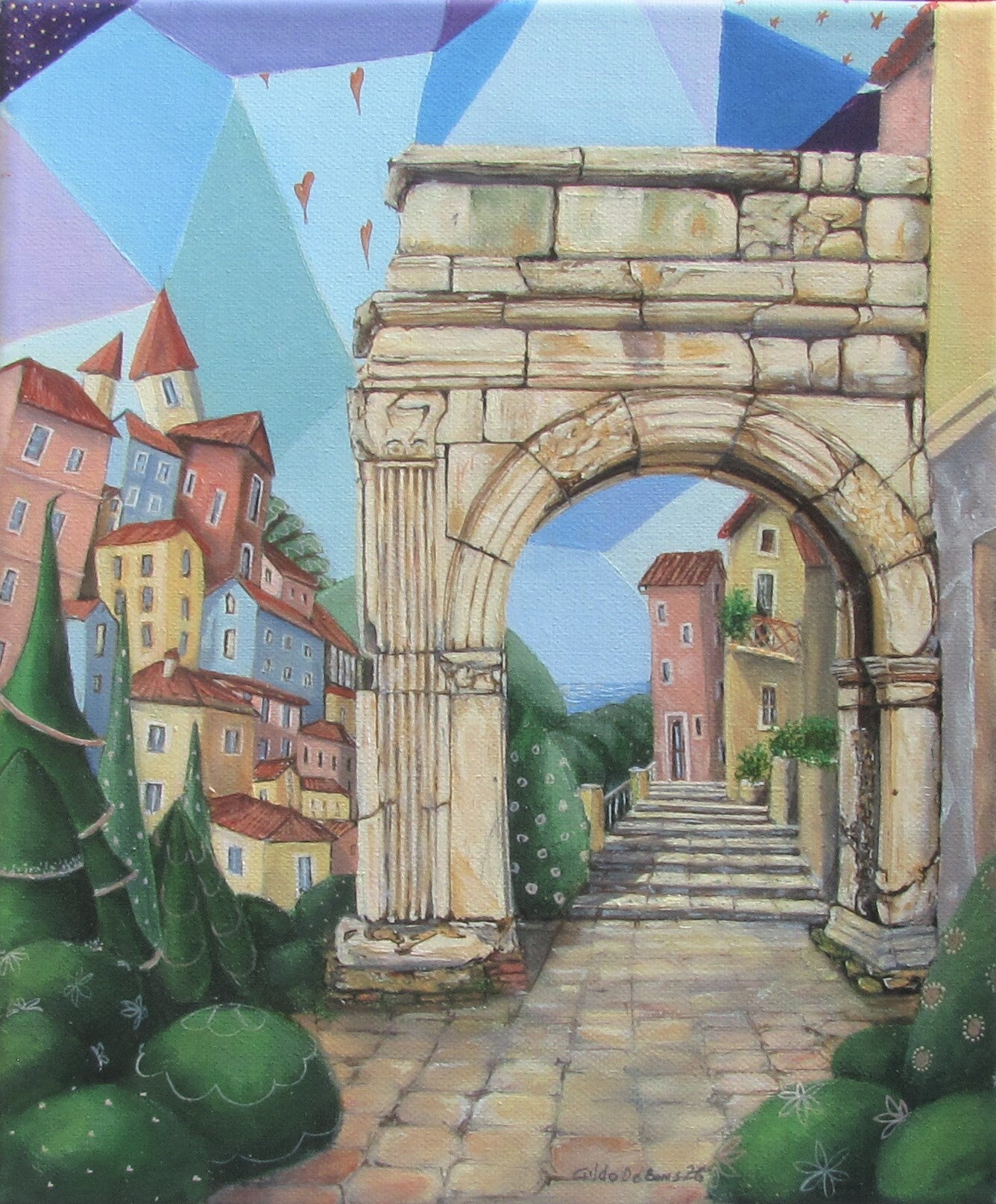
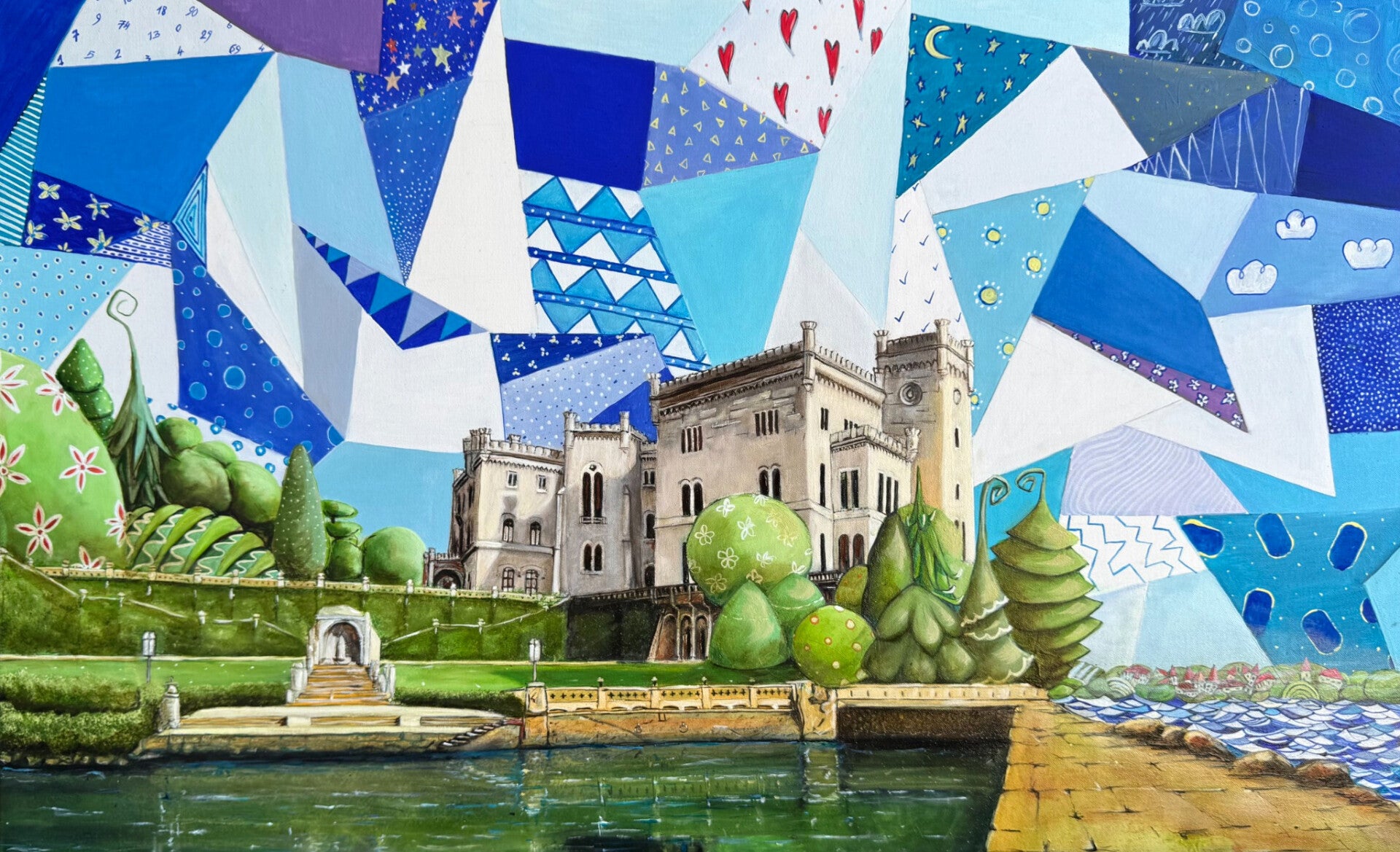
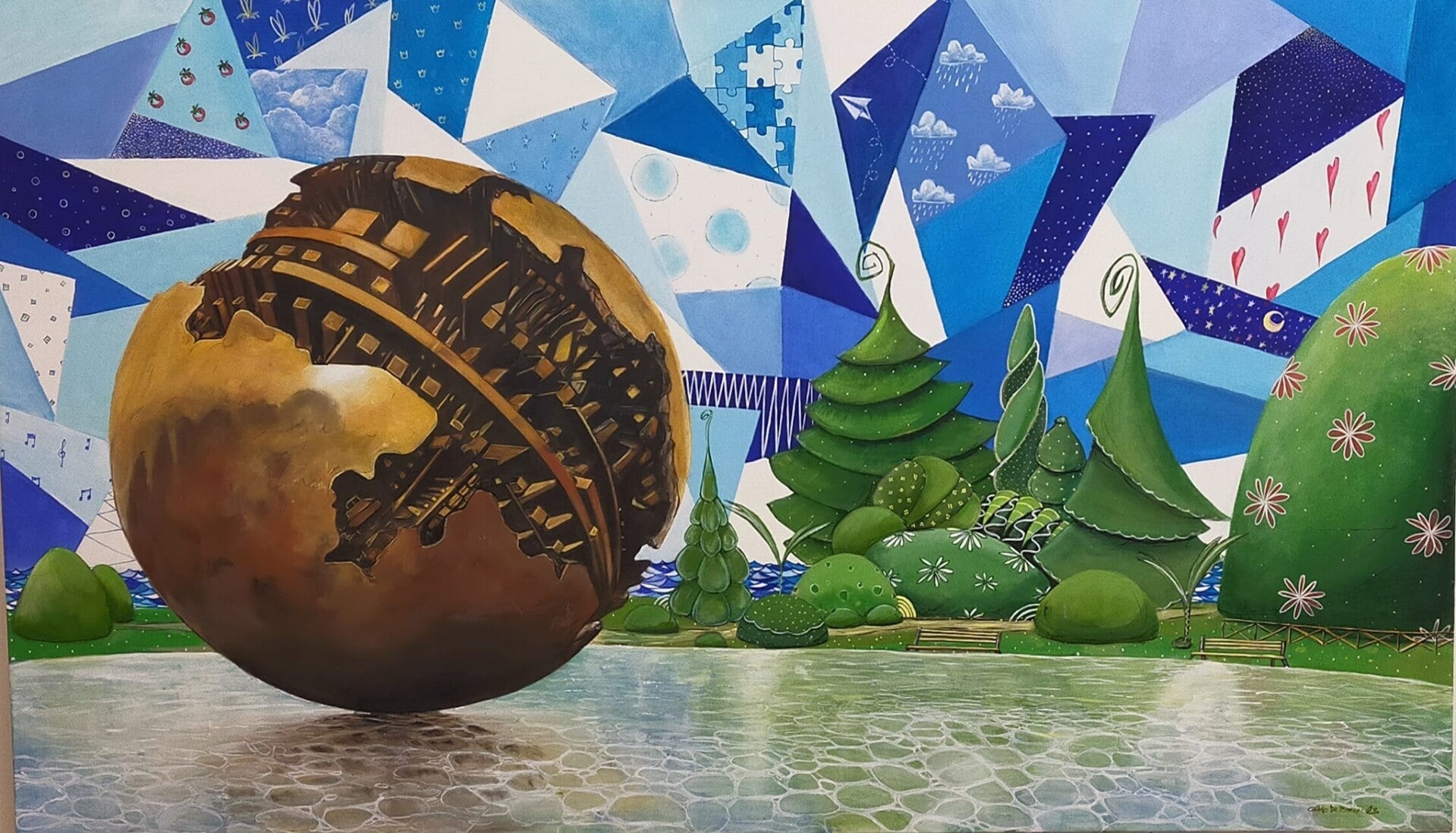
San Polo, Altrove
2026 · Oil on canvas · 25 × 30 cm
Available

Returning to the same place with different eyes
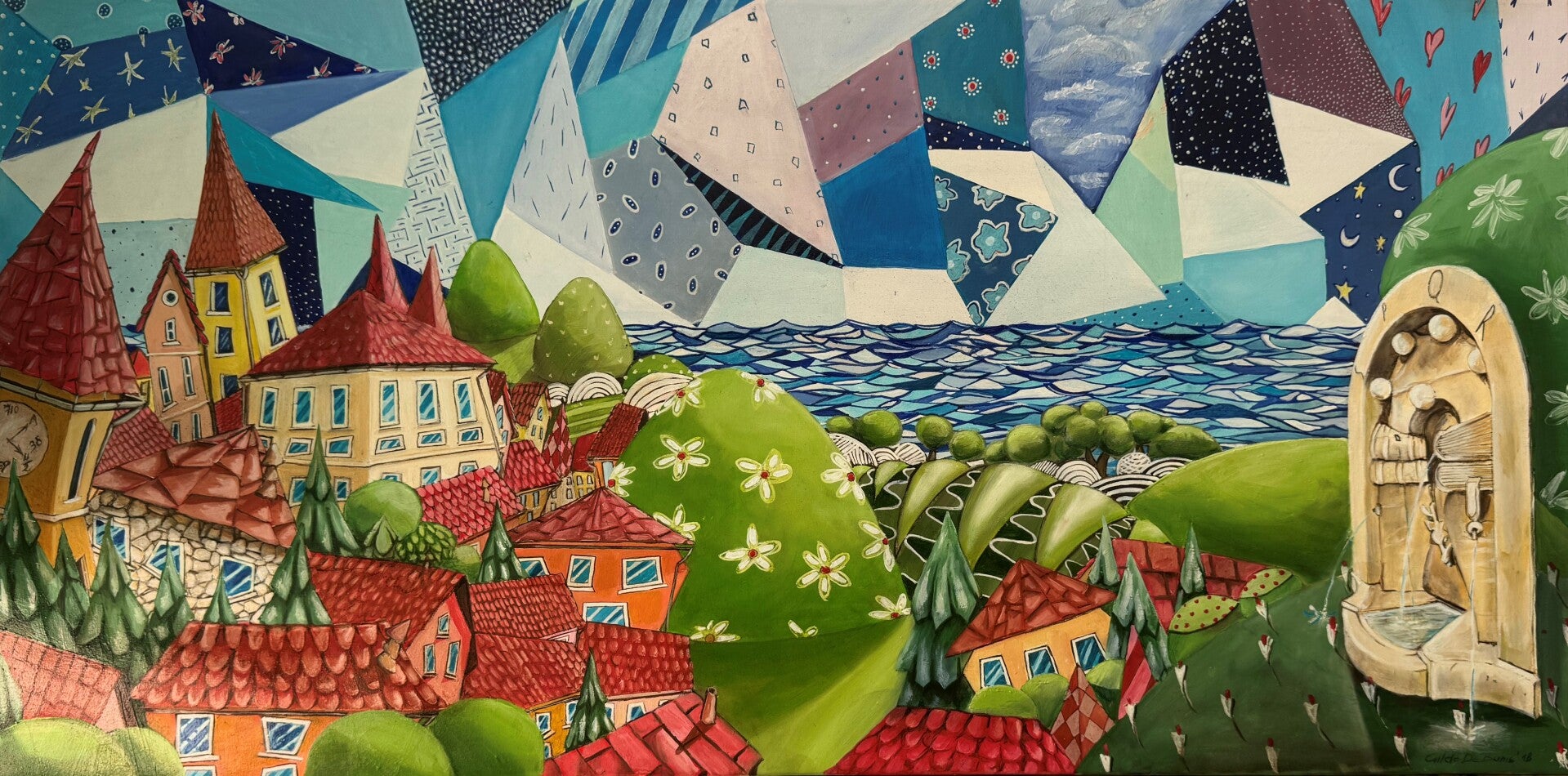
San Polo dei Cavalieri is the village where I grew up and where I lived until I was twenty, before joining the army and leaving. It is also a place I have painted several times over the course of my artistic journey, when I was still trying to faithfully reproduce the landscapes before me.
With San Polo, Elsewhere, I return to the same place, but no longer to represent it as it is.
The castle remains recognisable and faithful to reality, almost as if it were the fixed point of memory. Around it, however, the village is transformed: the houses lean, change proportions and colours, while retaining their volumes, light and depth. The vegetation becomes fantastical and the sky breaks apart into geometries, colours and signs.
It is still San Polo. But it is a San Polo transformed by time, distance and imagination.
Behind the work
For years I painted this village trying to portray what I saw. Returning to it today means using the same subject to measure how much my painting has changed.
San Polo, Elsewhere was painted on a canvas measuring just 25 × 30 cm, a deliberately compact format that concentrates a dense village of houses, the castle, the bell tower, the path, vegetation and a sky constructed through geometries and decorative elements within a very small space. Many of the buildings measure only a few centimetres, yet each one contributes to the depth and movement of the whole.
Those who know San Polo can recognise it, but they will not find it exactly as it is. The real place remains; what has changed is the way of seeing it.
Did you know?
San Polo dei Cavalieri lies in the Monti Lucretili, and its village developed over the centuries around the castle, which was associated with the Orsini, Cesi and Borghese families.
In the Origins section of this website, you can also find some of my earlier paintings of San Polo: works that are much more faithful to reality and offer a direct comparison between two different moments in my artistic journey.
A reflection
“I left San Polo many years ago. Today I return to it through painting: I recognise the same place, but I no longer need to paint it in the same way.”
Alle porte di Tergeste
2026 · Oil on canvas · 25 × 30 cm
Available

Every city preserves a threshold between what it once was and what it continues to become.
The Arch of Riccardo is one of the oldest surviving traces of Roman Trieste. Still standing in the heart of the old city, it appears as a fragment of ancient Tergeste that has endured through time.
In At the Gates of Tergeste, I wanted to preserve the monument’s identity and physical presence, while allowing everything around it to take a different path.
Beside and beyond the arch, an imaginary city emerges: houses change their proportions and colours, vegetation takes on fantastic forms, and the sky breaks into geometries, shades of blue and small signs. Even the path through the arch no longer leads simply towards a physical place, but towards a city suspended between the past and imagination.
The arch remains the fixed point. Around it, Tergeste becomes a possibility.
Behind the work
I have lived in Trieste for many years, and the Arch of Riccardo is one of those monuments that reveals a much older layer of the city than the one we encounter every day.
Painting it meant confronting this presence without transforming it. I therefore tried to preserve its recognisable structure, stone and traces of time, while entrusting the surrounding landscape to imagination.
The small format, just 25 × 30 cm, brings two different dimensions of time into the same space: that of the arch, rooted in history, and that of the imagined city growing around and beyond it.
Did you know?
The Arch of Riccardo stands today in Piazza del Barbacan, on the north-western slope of the San Giusto hill. It is traditionally interpreted as a monumental gateway of Roman Tergeste, connected with the city walls built under Octavian in 33–32 BC. The surviving structure is generally dated to around the middle of the 1st century AD.
The origin of the name “Riccardo” is also uncertain. One hypothesis suggests that it may derive from a transformation of the Latin word cardo, referring to one of the principal streets of a Roman city.
A reflection
“Some gates do more than allow us to cross a place. They cross time. Beyond the arch, I imagined a city that no longer exists and, perhaps, never existed quite like this.”
L'Equilibrista
2025 · Oil on canvas · 30 × 60 cm
Available

The most important symbols of a city are not always the best known.
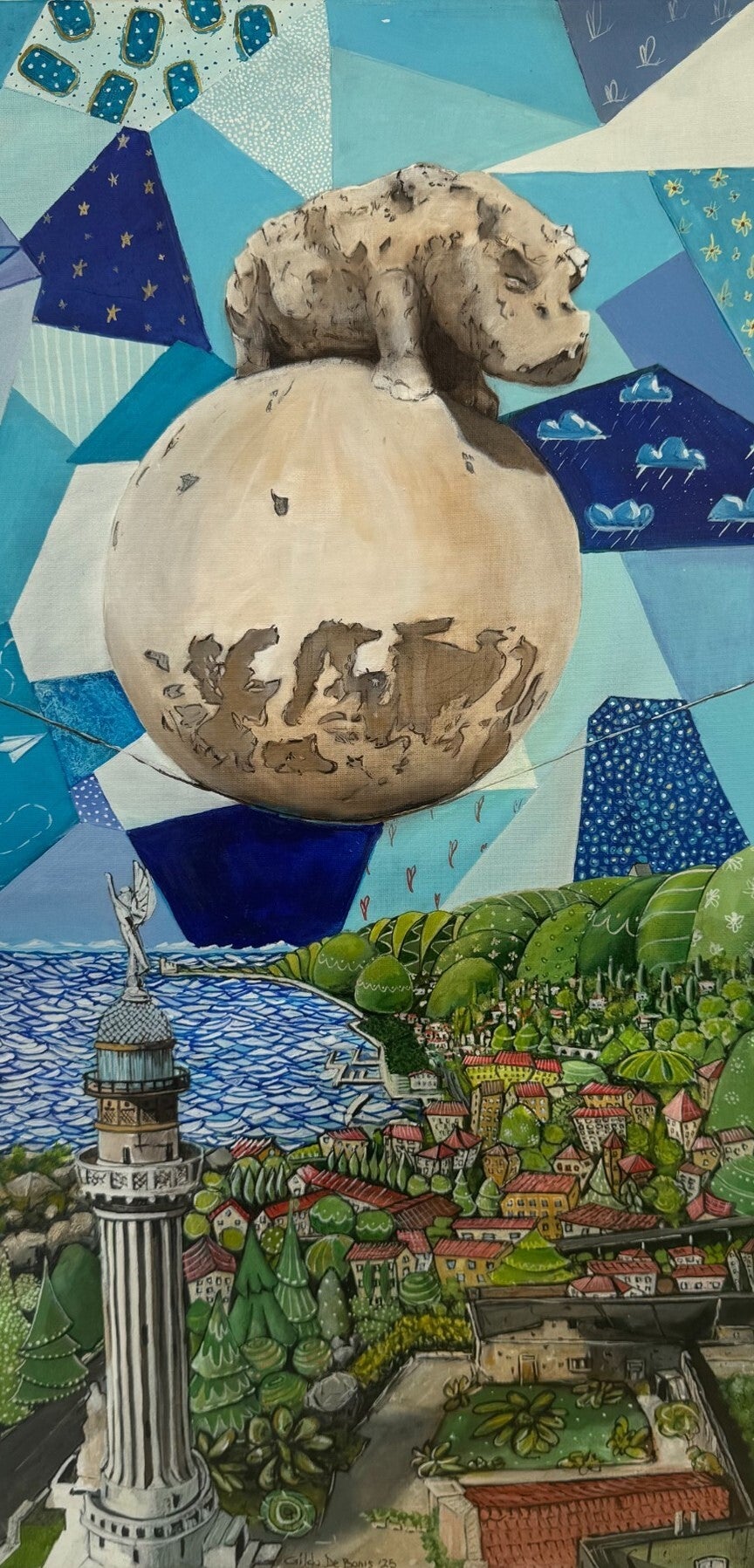
I chose to dedicate this work to the hippopotamus by Davide Rivalta because I consider it one of the most fascinating presences in Trieste, yet at the same time one of the least known to those who pass through the city. Every day hundreds of people walk past it without ever stopping. Yet all it takes is to pause for a moment and look at it.
That enormous animal, suspended in an apparently impossible balance, became for me a metaphor for Trieste: a city poised between the Karst, different cultures, memory and the future.
Beneath it, the city takes shape through the places I have come to know and love: the Faro della Vittoria, Roiano, Barcola, the port, the pine forest, the Karst, Monte Grisa — the Sanctuary of Mary Mother and Queen — and the little observatory. None of them appear exactly where geography would place them: they have entered my memory, and memory has transformed them.
Even the sky abandons reality: it breaks into geometries, colours and small symbols, carrying the landscape into a suspended dimension somewhere between what exists and what I imagine.
L'Equilibrista was born as an invitation to slow down and look: towards a sculpture that many have seen without ever truly observing it, and towards a city that, in my memory, can be rearranged freely.
Behind the Work
Walking past the Piscina Bruno Bianchi, I have often wondered why such a remarkable sculpture is so rarely spoken about.
I did not simply want to paint it. I chose instead to imagine it suspended above the city, transforming it into the silent observer of a Trieste shaped by my memories.
L'Equilibrista was born from the encounter between a real work of art and my personal vision of the city.
Did You Know?
The hippopotamus depicted in the painting was inspired by the sculpture by Davide Rivalta, located in Largo Ugo Irneri, beside the Piscina Bruno Bianchi in Trieste.
Created in resin and installed in 2004, it depicts a hippopotamus balancing on a large sphere and is one of the most unusual presences in the city's contemporary art landscape.
A Reflection
“Every city holds places that everyone sees but few truly observe. With this painting, I wanted to return a gaze to one of those places.”
Il Pomodoro
2023 · Oil on canvas · 120 × 70 cm
Private collection — Pesaro

When Reality Meets Imagination
Some works are born from a personal idea; others come to life through the trust of someone who chooses to entrust you with a place, a memory or an emotion through a commission.
Il Pomodoro was born from a commission and from the Sfera Grande by Arnaldo Pomodoro, one of Pesaro’s most recognisable landmarks.
The request I received was simple:
“The Sphere must remain real. You can do whatever you like with everything else.”
Those few words gave me extraordinary creative freedom.
The Sphere retains its identity, while everything around it is drawn into my imagination: the trees change shape, the sky breaks into geometries, symbols and small fragments of memory, and the landscape progressively loses its connection with reality.
It is precisely in the contrast between the solidity of the monument and the freedom of the space surrounding it that I recognise one of the fundamental elements of my pictorial language today.
Behind the Work
This work is also connected to someone very special to me: a childhood friend who has known both me and my work for many years and who, by entrusting me with this commission, gave me something precious — trust.
He did not ask me to imagine the Sphere differently. On the contrary, he wanted it to remain recognisable and real, leaving me completely free to construct the world around it.
That request helped me understand more clearly the direction of my research: not to transform the monument, but to transform the reality that surrounds it.
The work was so well received that, a few years later, the same friend asked me to return to the same subject with a second, smaller version set at night.
For me, it was another confirmation of something beautiful: being able to return, through a new work, to a story that had begun years before.
Did You Know?
The Sfera Grande by Arnaldo Pomodoro, located on Pesaro’s seafront, has become one of the city’s most recognisable landmarks.
Its outer surface, apparently perfect, opens to reveal a complex inner structure: a contrast between form, matter and depth that characterises Pomodoro’s artistic research.
A Reflection
“Trust is one of the most precious gifts an artist can receive. When someone entrusts you with a place and says, ‘You do the rest,’ they are giving you the freedom to tell it through your own eyes.”
Mira il mare
2022 · Oil on canvas · 80 × 50 cm
Available
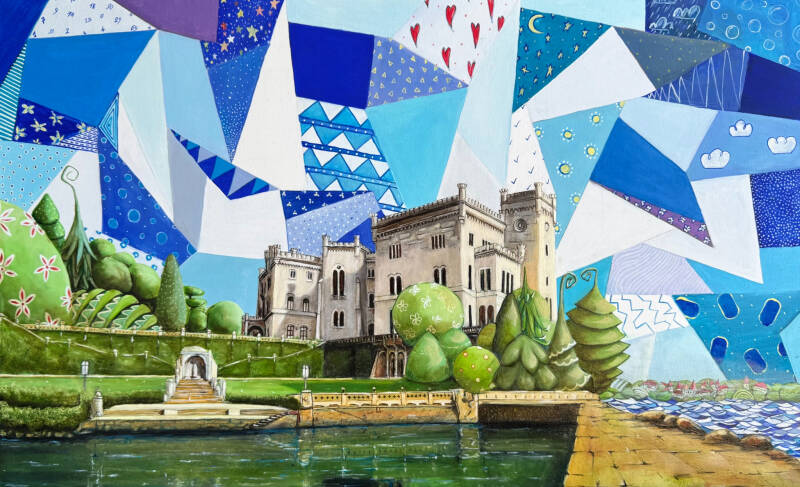
There are unique places that, even when we know them well, continue to suggest something beyond what we can see.
In this painting, I wanted to preserve Miramare Castle in its real and recognisable identity, while allowing everything around it to transform freely.
The vegetation takes on unreal, almost dreamlike forms; the sea stretches towards a small imagined landscape, while the sky loses every natural reference, breaking into geometries, colours, stars, hearts and small signs.
Reality and imagination thus coexist within the same space: the castle remains anchored to its real location, while around it a landscape takes shape that belongs more to memory than to geography.
Mira il mare was born from this contrast: starting from a real place and slowly moving away from it, without ever losing it completely.
Behind the Work
Miramare is one of the places that most immediately identify Trieste. Precisely for this reason, I did not want simply to reproduce a view.
I chose to leave the castle almost untouched and allow the landscape around it to change, just as places do when they enter our memories: some elements remain clear, others are transformed, and others still are invented.
Did You Know?
Miramare Castle was built in the nineteenth century for Archduke Maximilian of Austria and his wife Charlotte. Overlooking the Gulf of Trieste, it has become one of the city's most recognisable landmarks and a symbol of its relationship with the sea.
A Reflection
“The places we remember never remain exactly as we saw them. Memory preserves them, yet at the same time reinvents them.”
Leggimi di te
2018 · Oil on canvas · 40 × 80 cm
Available

Some monuments immediately capture our gaze, while others seem to wait quietly to be discovered.
The Fontana dei Libri, hidden away in Via degli Staderari, just a few steps from the Pantheon, belongs for me to this second category. Discreet, almost silent: like a book left closed, waiting for someone willing to open it.
Leggimi di te was born from this suggestion.
In the painting, the fountain preserves its connection with reality, while Rome slowly disappears around it. The houses begin to lean, the hills take on impossible forms, a sea appears where no sea could ever be, and the sky breaks into colours, signs and small symbols.
The title, however, does not speak only of books.
Above all, it speaks of people.
Each of us carries a story that cannot be known at first glance. Just as a book cannot be judged by its cover, a person needs time, attention and the willingness to listen before they can truly be known.
Behind the Work
Leggimi di te was born in 2018, during the same period as Un elefante si dondolava, when I was beginning to move away from traditional representations of places.
I was searching for a different way to tell their stories: to preserve something recognisable while allowing everything else to be transformed by memory and imagination.
The Fontana dei Libri naturally offered me this possibility. The water flowing between the books made me think of the stories that pass through our lives: some we read, some we listen to, and others we write without even realising it.
Did You Know?
The Fontana dei Libri was designed in 1927 by the architect Pietro Lombardi and is located in Via degli Staderari, in Rome's Sant'Eustachio district.
It is part of Lombardi's series of Fontane dei Rioni, created to evoke the identity of Rome's historic districts through symbols and images.
A Reflection
“Every person is a book that no one has finished reading yet.”
Un elefante si dondolava
2018 · Oil on canvas · 35 × 80 cm
Private collection — San Polo dei Cavalieri (Rome)

The Beginning of a New Language
Every artistic journey has a starting point. For me, it begins with this painting.
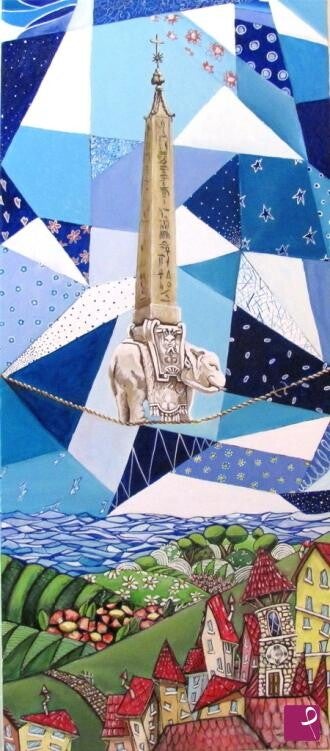
Un elefante si dondolava is the first work in which a real monument ceases to be simply a subject to represent and becomes the starting point for a story suspended between reality, memory and imagination.
The inspiration came from Gian Lorenzo Bernini's Elephant and Obelisk, just a few steps from the Pantheon. Looking at it, my mind almost instinctively returned to the nursery rhyme we all heard as children.
From that memory came the transformation: the elephant becomes a tightrope walker, moving along a rope suspended above an imaginary landscape. Beneath it, houses begin to lean, hills lose their real proportions, and the sky breaks into geometries and symbols.
I was not searching for a style. I was searching for a different way to tell the story of places.
Looking at this work today, I recognise the moment when I began to move away from simply representing reality and started to make room for what a place can evoke.
The painting was acquired shortly after it was completed by a collector who was already following my work and who still owns several of my paintings today.
Did You Know?
The Elephant and Obelisk was designed by Gian Lorenzo Bernini and unveiled in 1667 in Piazza della Minerva, Rome. The elephant carries an ancient Egyptian obelisk and has become one of the city's most distinctive monuments.
A well-known Roman tradition also tells that Bernini deliberately turned the animal's rear towards the nearby Dominican convent in response to changes imposed on his design. It is a colourful story, but its historical basis has never been established with certainty.
A Reflection
“Every journey begins with a step. Every artistic search begins with an intuition. Looking at this work today, I recognise the moment when I began to transform monuments into stories and places into landscapes of memory.”